


About two thousand years ago, in a corner of the world, something happened. Whether born of literary invention, the maturation of a small group of people, or the unique experience of one individual, a story began to circulate.
At its center was a certain figure—a “son of humanity”—who called into question some of the very pillars that the established order considered essential for human coexistence.
This figure, around whom many events were told, went on to become the focal point of much of modern Western thought.
Among the countless stories attributed to him, one brief passage has always struck me. It goes like this:
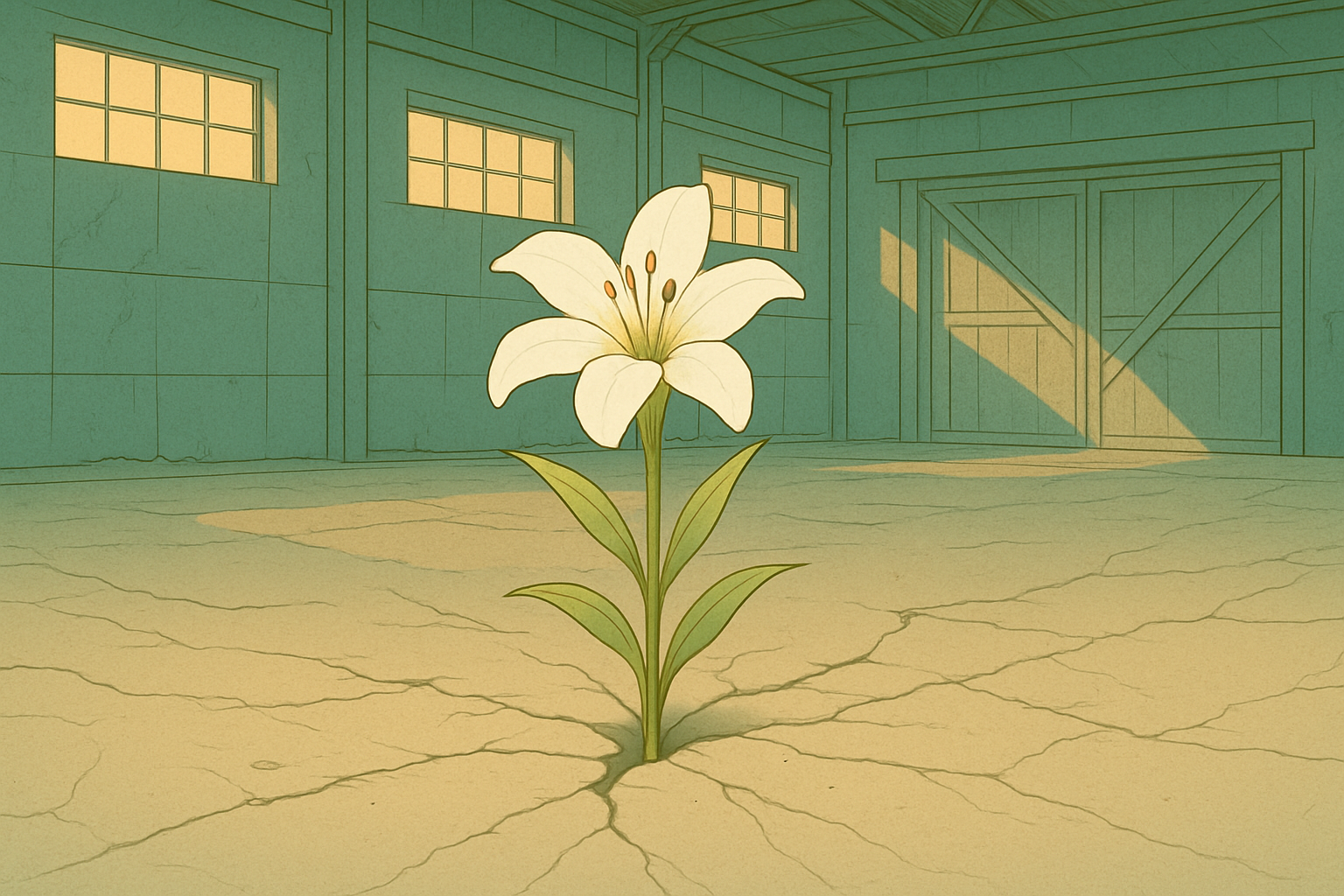
“Look at the lilies of the field, how they grow: they neither toil nor spin.
Yet I tell you, not even Solomon in all his glory was clothed like one of these.”
In these words, drawn from what is known as the Sermon on the Mount, this man—Yehoshua ben Yosef—offers an image that even then, but perhaps especially today, sounds almost provocative and subversive: do not be anxious for your life. And he adds:
“Seek first the Kingdom of God, and all these things will be given to you as well.”
If we replace the idea of God with “Life” understood as the immanent and relational principle of existence, the passage becomes a profound invitation to recognize, in the ecosystem—that “Kingdom of Life”—the capacity to meet human needs at their root.
This is not fatalism, but another kind of intelligence: an organic wisdom that acknowledges interdependence as both foundation and environment, within which our species’ needs can be fulfilled.
And yet, despite secularization having reshaped institutions and society, many still affirm—and often proudly claim—the influence of Christian values on European and Western culture.
From some Eurocentric perspectives, this influence is even defended as a civilizational cornerstone.
And yet, precisely on the concept of trust recalled above, it seems the champions of this civilization have looked the other way.
From their Enlightenment and mechanistic vantage point, they elevated another ideal:Homo Economicus —the abstract and reductive model of the human being conceived by modern economics, reduced to an individual driven solely by self-interest—enthroned as the pivot of modern development.
That “looking away” could have taken many forms, but in our history it found its strongest expression in neoclassical thought: Homo Economicus as the logical apex of a paradigm that shapes the human in the image and likeness of selfish accumulation.
From this angle, capitalism reveals itself for what it is: the structural negation of trust, the institutionalization of fear, the construction of a world where survival means to accumulate.
To accumulate goods, information, titles, guarantees.
An accumulation now confused with well-being, though it was born as a defense mechanism against a world perceived as unreliable, competitive, hostile.
It is in this rupture with original trust that capitalism shows its most contradictory face: the capacity for reliance that links every living being to the rest of Life is replaced by blind faith in an impersonal machine.
The vital bond gives way to mechanical order, relationship is replaced by performance, and thus Life cedes its place to the Machine.
And the Machine, as we know, requires technicians: those who keep its gears oiled and free of rust.
Technicians of functioning, prediction, optimization.
And so economists were born—and rose to a central role. Alongside them, supporting the architecture of this machine, moves a whole constellation of specialized roles: management engineers, marketing experts, managers, analysts, consultants.
Figures who rarely ask where the vehicle is headed, obsessed instead with its efficiency.
And yet, most of them hardly ever ask about the fuel.
About the origin of the resources that feed the system.
About the simple fact that no gear can turn forever if the ground beneath us is consumed.
That production carries hidden costs that someone, somewhere, is already paying.
Or worse: they do know, but prefer not to look, hiding the problem from themselves behind the technical term externalities..
To reinforce this drift, another telling sign can be seen: in economics courses, the discipline of commodity science has progressively disappeared.
Once, it was one of the few subjects that maintained a tangible link between economic thought and the physical reality of the world.
As Giorgio Nebbia (if memory serves) observed, this discipline—once devoted to studying the properties of goods, their natural origins, production cycles, and thus, at least potentially, their environmental impacts—is now absent from most curricula.
Where once students were taught what goods actually are, today they are taught formulas, curves, and models abstracted from the matter they represent.
This is not just an academic shift: it signals that economics has severed its last direct tie with living matter, turning into a self-referential system that treats goods and resources as numerical abstractions.
It is yet another expression of that same logic of detachment, of broken trust in concrete life, which opens the way to a purely symbolic economy, disconnected from the Living.
This detachment from reality—also reflected in the disappearance of commodity science—is the same fracture we find at the root of modern economic thought.
As Serge Latouche highlights in The Invention of the Economy (2010), economics, conceived as an autonomous and separate domain of social life, was born the moment the vital bond between humans and their environment was cut.
The individual ceased to be seen as part of an ecosystem, and was recast as an isolated rational agent, pursuing self-interest in a world conceived as external and hostile
Economics, then, is by definition the direct offspring of a loss of trust in the natural balance of living relations.
The Return to the Lily
Today, in the complexity of a world dominated by global profit networks, speaking of “the lilies of the field”may sound naïve.
And yet, it is precisely this image that probes us deeply.
It is not about imitating the stillness of nature, but about recovering a principle of alliance with it.
The logic of accumulation is not neutral: it carries ethical, ecological, and psychological costs.
As long as we continue to treat it as normal to invest in industries that produce weapons, exploit fossil resources, or practice intensive extraction, without questioning the collective consequences of those choices, we will continue to inhabit an economy of denial.
The return to the lily—to its quiet trust, to its non-accumulating presence—is not nostalgia.
It is a political possibility.
It is an invitation to rebuild direct bonds, to stop delegating, to refuse to treat security as a commodity, to prevent Life from being administered by those who ignore its web.
In the end, perhaps we do not need to invent a new system.
We need to recover a way of seeing.
A gaze capable of discerning—through the fog of profit—the simple splendor of the Living.
The lilies have not disappeared.
They still grow in our gaze, every time we choose not to measure the value of life in terms of production, control, or profit.
Every time that, like them, we place our trust—and we bloom.
Leave a Reply