


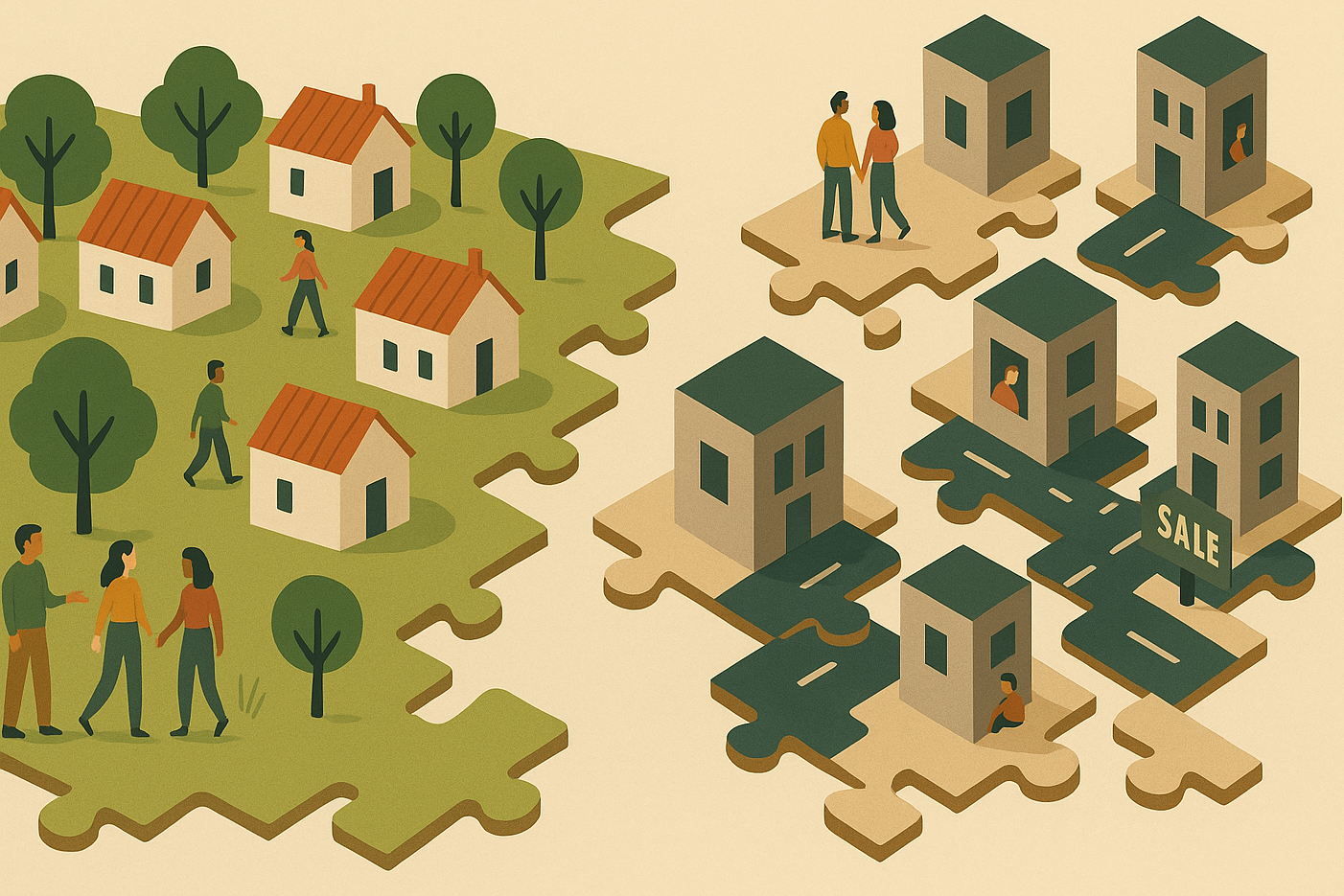
At nineteen, Marta had no doubts: she wanted to live on her own. It wasn’t a whim, but the natural desire for independence — a room of her own, her own rules, no one checking if she came home late or skipped dinner. The idea of closing the door behind her and knowing that small space was hers alone gave her a sense of achievement — of adult freedom.
But how much does this small story, which could easily describe the beginning of many young people’s experience today, really reflect the society we live in?
How many Martas — or Giulias, Giacomos, Stephanies, Jürgens, or Carloses — share that same longing for independence?
And when does this desire actually begin?
At what point does it turn into the need to live alone in an apartment?
Today, the desire for independence is seen as natural, almost biological.
Yet if we look closer, we might discover that it is largely a cultural construct — a desire carefully cultivated within a social context where almost every experience revolves around the individual, and “becoming an adult” means living alone, managing a private space, and proving you need no one.
But the drive to live alone has not always existed.
For most of human history, the very idea would have been incomprehensible: to survive meant to belong to a community, to share food, space, and responsibility.
If we look at the history of Homo sapiens, communal life has defined us as a species for roughly 300,000 years.
The agricultural revolution — which brought sedentary life and the rise of hierarchies — dates back only about 12,000 years, less than 5% of our story.
And industrial capitalism, which radicalized modern individualism, is barely 250 years old — less than one-thousandth of our existence.
This means that most of our brain and behavioral patterns evolved in a context of nomadism, small egalitarian communities, and deep connection with the ecosystem.
It’s no surprise, then, that evolutionary psychology speaks of evolutionary evoluzionisticowe are still adapted to a world that no longer exists, and we struggle to live in the one we’ve built.
This is not nostalgia for a mythical golden age, nor an idealization of the past as a better time. It is simply the recognition that our traits as a species developed over hundreds of thousands of years, while the world we inhabit today — born in the blink of an evolutionary eye — stands in sharp contrast with that long inheritance.
The aspiration to live alone is not only a cultural rite of passage; it also serves an economic function.
Since the agricultural revolution, community has never disappeared — it has simply transformed.
The first medieval cities offered a new kind of space: those who fled the bonds of feudal power could gain their freedom, hence the old saying, “city air makes you free.”
With industrialization came the next step: work was separated from land and village, and the individual became a unit of production — a cog in the machine.
From that moment, urban life and the market began to reward the mobile, self-sufficient individual rather than the member of a community.
In this process, the human need for social connection didn’t vanish — it was just reduced and confined within increasingly narrow boundaries.
From extended communities we moved to extended families, then to the nuclear family.
And within that shrinking circle, the pinnacle of social life came to be identified with the couple: romantic love as the ultimate expression of fulfillment, the promise that two people together can meet the full range of our need for connection.
But asking a single relationship to bear what was once shared among dozens of bonds is an impossible task.
Many of today’s fragilities and frustrations stem from this myth of the couple as a substitute for community.
What we now call “independence” is the product of this long transformation.
It has made it normal to think of living and social life as individual, private matters rather than communal ones.
An isolated individual must buy everything that, within a community, would once have been shared: childcare, elder care, companionship, even leisure time.
È un processo che può essere indicato come “ricomprare il villaggio”: ciò che prima era relazione diventa servizio a pagamento.
In a community, value emerged from reciprocal exchange — time, care, skills, presence.
In the modern world, those gestures have been progressively monetized.
Helping a neighbor became home assistance; cooking together became catering; taking care of children became babysitting.
Every fragment of collective life has been turned into an economic transaction.
We haven’t stopped needing the village — we’ve just learned to buy it in pieces.
The market has taken the language of community and resold it — with a price tag and a receipt.
But no payment can restore that sense of belonging which once came not from ownership, but from being together.
Rispondi